Reminiscences on Learning and Teaching American Indian Law, 1987–2024
by Bryan H. Wildenthal (January 5, 2024)
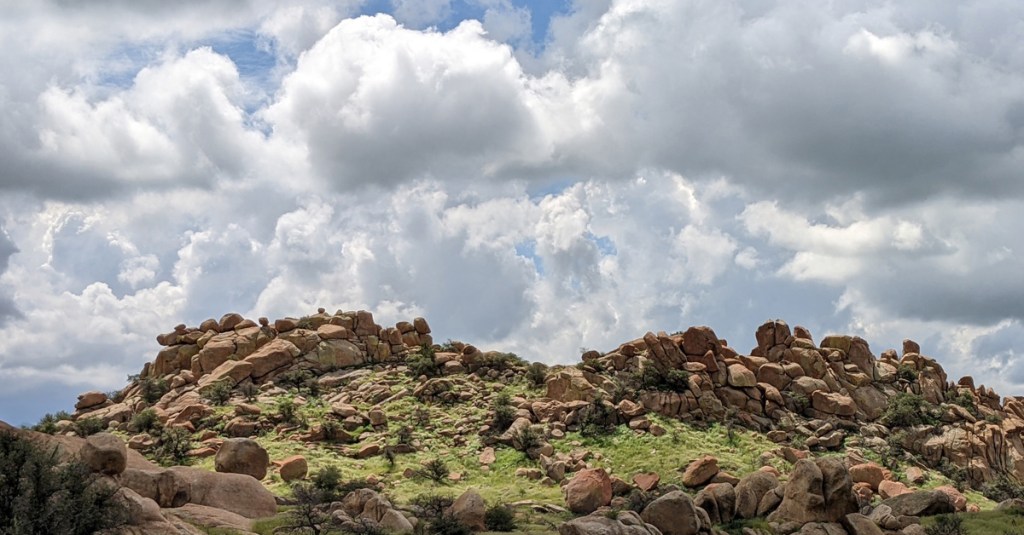
(Updated Sept. 12, 2024. See Copyright & Permissions Note on Vita & Contact page. Photo by the author: Texas Canyon, Arizona, Aug. 22, 2022.)
The Spring 2024 semester (starting January 9), will be the 18th time I teach American Indian Law. I taught it 16 times at Thomas Jefferson School of Law (TJSL) over the 20 academic years from 1996–97 to 2015–16, and for the 17th time in Spring 2021 at the University of San Diego School of Law. (Update, Sept. 12, 2024: I am now scheduled to teach the course for the 19th time, in Spring 2025, at California Western School of Law.)
For most of those years, this was the only such course taught at any California law school south of Los Angeles. The syllabus used in Spring 2024 may be viewed here. The publicly available course materials used in Spring 2024 are in a Google Drive folder here. (The syllabus and readings used in Spring 2025 at CWSL will be similar with some differences.)
I first taught the course in the Fall of 1996, my very first semester on the TJSL faculty and the first time the course was ever offered in the school’s then-27-year history. I did so in response to a request from Dean Kenneth J. Vandevelde, who had some experience with Indian Law during his years in private practice and had received requests from students for the school to offer the course.
Dean Vandevelde, upon hiring me as a new assistant professor, noticed on my vita a co-authored unpublished essay, “Native American Religious Rights,” which I had just completed. It appeared in print a few years later as a ten-page entry in Religion and American Law: An Encyclopedia (Paul Finkelman ed., Garland, 2000) (p. 330). He also noted that I was the only member of the faculty who had even taken the course in law school and had any familiarity at all with the subject, aside from himself.
I had indeed taken Federal Indian Law at Stanford just nine years earlier, in Fall 1987, taught by Adjunct Professor Al Logan Slagle (Cherokee). Slagle was a wonderful professor, gregarious, very supportive to students, and profoundly knowledgeable about Indian country. He was not a career academic but a busy practitioner of Indian law, working at various times for California Indian Legal Services and the Association on American Indian Affairs. He died far too young (only 51) in 2002.
That was the first time, at least in many years to my knowledge, that Stanford offered the course. No one on the regular faculty, then or for decades afterward, had any expertise in the field or even much interest as far as I could tell.
Things have changed quite dramatically at Stanford Law School, which in 2015 hired Professor Gregory Ablavsky (a non-Native like me), who has published very important historical and legal scholarship on the Indian Commerce Clause and the early U.S. Government’s relations with Indian Nations.
Stanford hired Professor Elizabeth Hidalgo Reese (Nambé Pueblo) in 2021, the same year that Deb Haaland (Laguna Pueblo) was appointed by President Biden as the first Native American ever to serve as U.S. Secretary of the Interior. Both Professors Ablavsky and Reese teach and write in the field of Indian Law among other subjects.
I still recall Stanford Law School Dean John Hart Ely commenting offhandly in 1986, in a speech to students soon after I started that fall, that the Indian Law course would be offered in response to student petitions.
I was already (and remain) a great admirer of Ely, having avidly read his classic book Democracy and Distrust as a high school student (yeah, OK, I was a total junior law geek). I came to have great affection for him as a professor when I took his course on “War and the Constitution.” He was very generously supportive of my later scholarly work in constitutional law and history. Like Slagle, Ely also died far too young (in 2003 at age 64).
But, I regret to report, Ely was rather dismissive in that 1986 speech about the value of Indian Law as a course, suggesting a bit patronizingly that students didn’t understand what a boring and technical field it actually was. As noted, I don’t think he or anyone on the Stanford faculty at the time actually knew much about it.
It is a demanding and complex subject, as I discovered both as a student and later as a professor, though hardly more so than many other law school courses (looking at you, Bankruptcy Law). But boring? Never!
It has been both a privilege and a challenge for me, as a non-Indian, to teach this course for so many years. I point out to my students each time that I am learning and re-learning the subject every bit as much as they are. And I learn a great deal from my students every time I teach it.
One Native student in my very first class went on to become a law librarian at a major firm. Another student in that same class, Janet Baker, published her course paper the very next year (1997) in Duke Law School’s Environmental Law & Policy Forum.
As I ruefully note, that was five years before I published my own first significant Indian law article! I laughingly commented to her: “You know, there are professors here who would kill to get an article published at Duke!” A few other students over the years also succeeded, like Baker, in getting their course papers published.
Another student, Bryan Sklar, wrote an outstanding paper in 2004 that in turn inspired me to write what became my most significant article in the field and one of the two most important scholarly articles of my career so far: “Federal Labor Law, Indian Sovereignty, and the Canons of Construction” (2007).
(Educational privacy laws mandate discretion in discussing current or former students. I only name these two because Baker published her work and Sklar gave me permission to publicly thank him and cite his unpublished paper, as I did several times, in my 2007 article; if you glance at p. 526 you’ll see I quote an especially compelling point he made.)
In the past I typically provided students the option of writing a major research paper for the course or taking it on an “exam only” basis. I encouraged students to write papers on aspects of Indian law that I often don’t have time to cover in a one-semester survey course. While I no longer provide that paper option, due to exam and grading administrative issues, I continue to be available to advise students on independent paper projects, especially after they complete the course.
Many students have written excellent papers on topics like Native religious and cultural rights, preservation of Native languages, environmental protection in Indian country, Alaska Native or Native Hawaiian issues, and challenges affecting various specific tribes including those straddling the U.S.-Canada and U.S.-Mexico borders.
One year an especially enterprising older student — a non-Indian who I think did not have any prior connections or knowledge of Indian Country — basically invited himself over to the Colorado River Indian Reservation, many hours from San Diego. As I recall, he spent several days there doing research, even persuading the tribal police to take him on a ride-along around the reservation! The result was one of the most fascinating and educational student papers I’ve ever read.
After my first foray in the Fall of 1996, I taught the course again at TJSL in Fall 1998, and then there was another lull of two years before we were able to offer it a third time in Spring 2001. I continued to teach it on an almost annual basis for the next decade and a half: to be precise, from Fall 2002 to Fall 2004, then Spring 2006 to Spring 2013, and then again in Spring 2015 and 2016 (in addition to those 16 times, I taught a one-unit intersession version of the course in May 2015).
After 2016, however, other teaching demands and the school’s downsizing in 2018 (the year I took emeritus status) prevented it from being offered again there for eight years, until this spring. But in the meantime, I had the very good fortune of being invited to teach the course at the University of San Diego (USD) School of Law in Spring 2021.
That was the first time in many years that USD had offered the course — yet again in response to student demands, just as at Stanford and TJSL!
Are we seeing a pattern here?
The responses of students to the course at both TJSL and USD have been very positive. (Update, Sept. 12, 2024: The Spring 2024 course went well. The students were engaged in the subject and several wrote interesting papers, including on Native American history education in K-12 schools, manufacturing as a component of tribal economic development, criminal jurisdiction in Indian country, and the relationship between Black and Native racial identities. I am now scheduled to teach the course again in Spring 2025 at California Western School of Law.)
I have been pleased to see USD continuing to offer the course, taught since as it happens by two Native American women, most recently my friend and colleague Angela Medrano (Cahuilla), a graduate of USD and President of the Native American Lawyers Association of San Diego County (NALA), which welcomes both Native and non-Native legal professionals and students interested in the subject.
I got to know Angela’s mother, Anna Monguia, and her uncle Gene Madrigal, in the late 1990s and early 2000s, when Anna was the President of NALA. Anna’s elder brother Anthony Madrigal Sr. is the first to graduate from law school in their family and indeed in the history of their tribe (the Cahuilla Band of Indians). Anna is the second and her younger brother Gene is the third. Anna and her husband Manuel Monguia operate a small law firm together. Angela jokes that NALA follows a matrilineal tradition.
I decided last year to dispense with a standard casebook and instead simply assign (and provide free of charge to students) my own selection of cases, treaties, articles, and other primary and secondary source readings. I do, however, require students to buy and read substantial portions of two supplemental books (whose combined cost is a small fraction of the expense of a single typical law school casebook).
Indeed, I now structure the course to a significant extent around one of those supplements, Indian Law Stories (Carole Goldberg, Kevin K. Washburn & Philip P. Frickey eds. 2011) (“ILS”), part of Foundation Press’s deservedly acclaimed series exploring the origins, social background, context, and litigation history of famous cases taught in various law school subjects.
ILS is now available in a Kindle ebook version which conveniently retains the pagination of the original paperback. I tell students either edition is acceptable. Even if you already own the printed edition, I urge everyone to support this excellent book by buying the Kindle version as well. Books don’t get written by magic! Authors, editors, and publishers need to earn a living!
The other supplement is a classic of American history and literature: Zitkala-Sa (Gertrude Bonnin), American Indian Stories, Legends, and Other Writings (Cathy N. Davidson & Ada Norris eds., Penguin Books, 2003), also available in both Kindle and paperback editions. Since the modest cost of both editions is the same, and the original pagination is not carried over to the Kindle (a major annoyance of most ebooks), I recommend the printed edition.
I should note, however, that during most of the years I’ve learned and taught this subject, I have benefitted from and relied greatly upon each of the three leading casebooks, all of which I have assigned as the primary course text at various times. I have come to know them well.
Getches, Wilkinson & Williams, Federal Indian Law (written with various co-authors since it first appeared in 1979), remains an indispensable classic. This was the book from whose second edition (1986) I learned the subject at Stanford and with whose third edition (1993) I first taught it in 1996. Professor Matthew Fletcher (Grand Traverse Ottawa and Chippewa), of the University of Michigan Law School, is now the leading co-author.
Second is the casebook I first came to know as Clinton, Goldberg & Tsosie, American Indian Law, in its fourth and fifth editions (2003 and 2006). It’s actually even older than GWW, originating as Monroe Price’s pioneering textbook first published in 1973.
As I comment in a footnote to my 2007 article noted above, Professor Carole Goldberg of UCLA School of Law, co-editor of both ILS and the latter casebook, has “provided friendly advice, encouragement, and assistance over the years,” to me among many, many others.
Anderson, Berger, Frickey & Krakoff, American Indian Law (2008), published most recently as Anderson, Krakoff & Berger (4th ed. 2020), is an outstanding new entry in the field.
I always make a point of inviting Native American attorneys to speak during several class sessions. Guest speakers have included Angela Medrano (Cahuilla) (mentioned above), and also Joanne Willis Newton, a Canadian First Nations lawyer (Chisasibi Cree) who specializes in Indian child welfare cases. Both also serve as Judges Pro Tem on the Intertribal Court of Southern California (ICSC).
Another, Devon Lee Lomayesva (Santa Ysabel Kumeyaay), graduated from the third San Diego law school (California Western) after the time I started teaching this course. She is now Chief Judge of the Intertribal Court.
I have often been honored to have Lawrence Baca (Pawnee) as a guest speaker. Now retired in San Diego, Baca was a civil rights litigator in the U.S. Department of Justice, former President of the Federal Bar Association (FBA), and longtime leader of the FBA Indian Law Section (see more details in the links and under Class 24 in the syllabus).
I had seen Baca speak as early as 2000 or so at the annual FBA Indian Law Conferences, of which he has long been a guiding force. But I only properly met him in October 2009 at a California Indian Law Association meeting in Sacramento, thanks to a friendly attorney I didn’t even know that well who suggested the three of us grab dinner together.
Lawrence and his wonderful wife JoAnn have become dear friends of my husband and me (and my mother-in-law who lives with us). Such fortuitous connections have been among the best things about working in this area.
All these connections came in handy when I had the honor in February 2011 of being the lead faculty organizer of TJSL’s annual Women and the Law Conference, focusing that year on Native American Women and the Law.
Surveying the list of speakers, it is interesting to see at least two future law school deans — Stacy Leeds (Cherokee) and Elizabeth Kronk Warner (Sault Ste. Marie Chippewa) — and at least one future federal judge — Diane Humetewa (Hopi), who in 2014 became the first Native American woman to serve on the federal bench.
Over the years I’ve given many lectures on Indian law at conferences, libraries, and continuing legal education events. A few examples follow.
I spoke at the Annual Meeting of the Association of American Law Schools in New York City (January 2008) on “Labor and Employment Laws in Indian Country.” At the Continuing Education Center in Rancho Bernardo (November 2009) and the San Diego Law Library (January 2010), I spoke about “The Native American Contribution to American Constitutional Law.”
In October 2010, during my time as a board member of the California Indian Law Association, I co-organized the group’s Tenth Annual Conference at the Pala Resort, including a panel focusing on the 20th anniversary of the Native American Graves Protection and Repatriation Act, “Protecting Cultural Heritage Under Federal and California Law.”
On November 6, 2013, I was privileged to share the stage with historian Michael Connolly Miskwish (Campo Kumeyaay), an expert on the Indian heritage of San Diego County. Many people are unaware we have more active federally recognized Indian Nations — 17 to be exact — than any other county in the U.S.
The latter event was held at Thomas Jefferson School of Law and co-sponsored by the San Diego Public Library and our local KPBS radio and TV station, moderated by anchor Tom Fudge. It focused on “Education, Colonization, and the Law in Native American History.” Two days before the event, Connolly Miskwish and I engaged in a wide-ranging interview with KPBS’s Maureen Cavanaugh.
On April 10, 2015, I presented a talk at the Federal Bar Association’s 40th Annual Indian Law Conference (Talking Stick Resort, Salt River Pima-Maricopa Indian Community, Arizona), on “Indian Sovereignty, General Federal Laws, and the Canons of Construction: An Overview and Update.”
I developed that 2015 presentation into a major article, published in 2017, summarizing my years of study of the “Indian Law Canons” governing judicial review and interpretation in this field.
It’s a bit of a shock to realize more than 20 years have now passed since I published a college-level textbook surveying the nature and importance of Indian sovereignty.
I pause sometimes to think how much I personally owe those law students at Stanford (before I even started there in 1986) — and at TJSL (before I started there in 1996) — who goaded both schools into offering this course, thus opening the door to this field for me and fundamentally altering my entire career, and indeed my life.
Dean Vandevelde didn’t need much goading at TJSL. He was very receptive to the student appeals and was grateful, being too busy as dean to teach the course himself, that he found in me a somewhat unlikely candidate to take on the responsibility. I owe him a lot for that and for hiring me at TJSL in the first place.
As I look back today, 1986 seems like a long time ago. But 1996, though now 28 years in the past, often feels like only yesterday. The years and decades pass quickly.
 The Skeptical Professor