An “Exquisite Balance”
by Bryan H. Wildenthal (July 10, 2023)
(See Copyright & Permissions Note on Vita & Contact page.)
As a son of two scientists (my father was a nuclear physicist and my mother a biologist), I have felt a passionate lifelong commitment to fact-based reason and rigorous inquiry into all fields of study including science, law, history, and literature.
We must always strive to avoid not just blatant ideological or emotional prejudices of various kinds, but their more subtle and dangerous cousins: motivated reasoning, confirmation bias, belief perseverance, and other cognitive pitfalls.
I have never endorsed the lazy and all-too-fashionable tendency to reflexively and cynically distrust all established scholars and conventional authorities. The vast majority of scholars engage sincerely in the search for truth — something we can probably never fully discover but to which we can get closer over time.
As the Nobel Prize-winning economist and New York Times columnist Paul Krugman has noted, it is a “fact of life that most of the time conventional wisdom and expert opinion are right.”
But all authorities must be subject to reasonable questions. Scholarly work must always be open to skeptical and critical examination and should only be followed to the extent justified by the facts and by rigorous analysis.
In my career as a law professor I’ve had more than ample exposure to academic humbug. Scientists and other scholars are not immune from prejudice or cognitive bias. I have seen in my own field how spectacularly (even tragically) wrong conventional wisdom and long-established orthodoxies may be.
My most important work on American constitutional history, culminating in an article cited in two major U.S. Supreme Court decisions, helped overturn a suffocatingly dominant conventional view about the central meaning of the U.S. Constitution’s 14th Amendment (1868) in relation to its Bill of Rights (1791) — an orthodoxy that reigned supreme at leading American law schools for half a century but which turned out to be profoundly mistaken.
Many specific cases dealing with that relationship have been hotly disputed. But judges, lawyers, and scholars from the ardently liberal to the strongly conservative have largely come to agree that the former consensus was fundamentally mistaken. The guarantees of the Bill of Rights, as contested and difficult as they often are to interpret, apply not just to the federal government but — through the 14th Amendment — to state and local governments as well. Yet just a few decades ago this idea was widely dismissed by many if not most historians and legal scholars as “eccentric” and wrong.
In today’s deeply troubled world, with increasingly polarized and paranoid political divisions besetting almost every nation, it is understandable that so many people across the ideological spectrum are tempted to reject “establishment” views and embrace a vast range of far-fetched and conspiratorial notions.
Many people on the left resist the insights of evolutionary biology on nature vs. nurture, while many on the religious right reject evolution altogether. Many on the right have resisted the overwhelming scientific evidence for human-caused global warming, while many on the left have long embraced an exaggerated view of the dangers of nuclear energy — the only realistic hope to fully escape our destructive dependence on fossil fuels.
Unholy alliances of leftwing and rightwing skeptics have embraced unfounded fears of vaccines — fears repeatedly debunked by scientific studies. Faced with occasional unexplained aerial phenomena, and besotted by decades of exposure to science-fiction movies, they have fallen far too credulously for the wishful thinking (or thrilling fear) that aliens routinely visit Earth, abduct humans, disembowel cattle, and carve crop circles in fields.
Look, I’m a huge science-fiction fan! Alien intelligence of some kind surely does exist somewhere, or has, or may in the future. It seems implausible that human intelligence could be or remain unique in our vast universe.
But only the most irrational and egotistical anthropocentrism could explain the widespread human conviction that other spacefaring beings are going to the extraordinary effort required to visit and focus so much attention on our obscure corner of the cosmos — during our brief “hour upon the stage” in the vastness of time.
Please! We must get over ourselves!
Carl Sagan, the astronomer and visionary exponent of science and rational inquiry, captured the dilemma best. He called for “an exquisite balance between two conflicting needs: the most skeptical scrutiny of all hypotheses that are served up to us and at the same time a great openness to new ideas.”
“If you are only skeptical,” Sagan urged, “then no new ideas make it through to you. You never learn anything new. You become a crotchety old person convinced that nonsense is ruling the world. There is, of course, much data to support you.”
“On the other hand, if you are open to the point of gullibility and have not an ounce of skeptical sense in you, then you cannot distinguish useful ideas from the worthless ones.”
Sagan, “The Burden of Skepticism” (1987 lecture), quoted opposite the table of contents of Michael Shermer’s important book, Why People Believe Weird Things (1997, rev. 2002).
Skeptics are, of course, often wrong (perhaps more often than those adhering to mainstream consensus views). It is very easy to become too reflexively skeptical of either mainstream beliefs or seemingly far-fetched contrarian ideas.
It is important to be reasonably skeptical of established or consensus views. Such views are sometimes overturned for good reasons. But it is equally important to be skeptical of dissenting or contrarian views. We must be skeptical of the skeptics too. Every belief, and every critic of every belief, should be put to the same test of facts and reason without fear or favor.
Krugman noted that when it comes to established mainstream views, “there can be big … payoffs to finding the places where they’re wrong. The trick … is to balance on the knife edge between excessive skepticism of unorthodoxy and excessive credulity.”
“It’s all too easy,” Krugman notes, “to fall off that knife’s edge in either direction. When I was a young, ambitious academic I used to make fun of stodgy older economists whose reaction to any new idea was ‘It’s trivial, it’s wrong and I said it in 1962.’ These days I sometimes worry that I’ve turned into that guy.”
“On the other hand, reflexive contrarianism is … a ‘brain rotting drug.’ Those who succumb to that drug ‘lose the ability to judge others they consider contrarian, become unable to tell good evidence from bad'[.]” They fall prey to “‘a total unanchoring of belief that leads them to cling to low quality contrarian fads.’”
Krugman, “The Rich Are Crazier Than You and Me,” New York Times (July 6, 2023) (quoting economist Adam Ozimek).
Let me close with a final wise thought from Carl Sagan. He pointed out that “reasoned criticism of a prevailing belief is a service to the proponents of that belief; if they are incapable of defending it, they are well advised to abandon it.”
Sagan, Broca’s Brain: Reflections on the Romance of Science (1979, pp. 82–83; pap. ed. 1980, pp. 96–97).
Postscript:
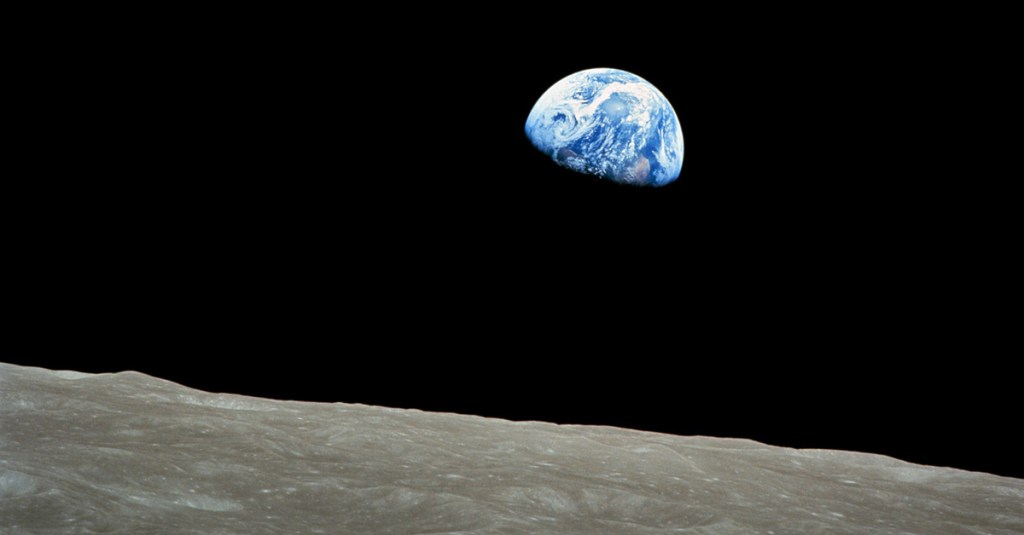
Photo credit (top of this page): Earthrise, NASA, Apollo 8, December 24, 1968, taken by astronaut Bill Anders.
This is, I think, the most important photograph there has ever been or will ever be in the history of the human race, as it showed our planet for the first time to most of humanity in proper perspective — not as a “world,” not as a seemingly flat or slightly rounded surface with sky above and ground below, seemingly the center of the universe — but as a small and fragile body in space, seen from our moon, neither body remotely near the center of anything.
I feel extraordinarily lucky to have lived during the time this new perspective was born. It is fashionable to be cynically skeptical of the importance of humanity traveling to the Moon. I think that’s profoundly mistaken. Humanity’s first journey there in Apollo 8 and the 1969 Apollo 11 lunar landing were epically important events and this will become ever more clear with time. This book, among others, explains why. India’s recent landing of a robotic craft near the lunar south pole is also a major leap forward.
But the change in perspective these achievements have wrought may be even more important than the near-term scientific, economic, and other material consequences.
A favorite story in my family is that my aunt Lolly Lockhart practically propped my eyes open late at night so I would witness live, at age 5, the Apollo 11 landing on the Moon. I have no memory of it but I’m glad she did! I do remember watching several of the later Apollo missions and grew up fascinated by a print of the Apollo 17 “Blue Marble” photograph of Earth taped to the wall in my maternal grandparents’ house.
To similar effect, though less vivid, is the later “Pale Blue Dot” photograph made famous by Carl Sagan (NASA, Voyager 1, February 14, 1990).
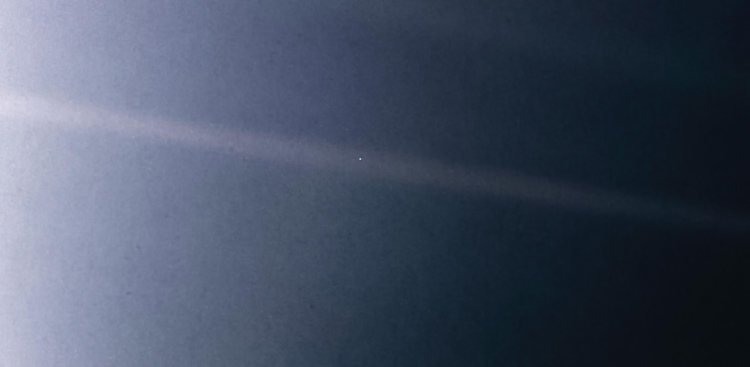
There are several versions on YouTube of Sagan’s important and justly admired “Pale Blue Dot” speech inspired by the photograph (with visual and musical backgrounds of varying quality). He seems to have given his first and eloquently short version of it on June 6, 1990, the day the photograph was publicly released. The full text (PDF here) appears in his must-read book Pale Blue Dot: A Vision of the Human Future in Space (1994) (pp. 6–7).
The classic authorized version of the full speech (with beautiful but disappointingly low-resolution space imagery) is available here. My personal favorite version (so far) is embedded here:
 The Skeptical Professor